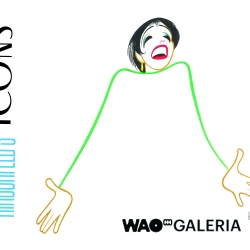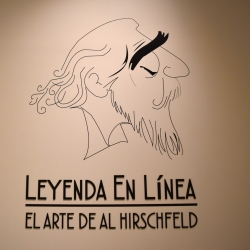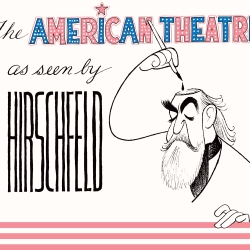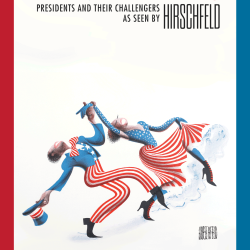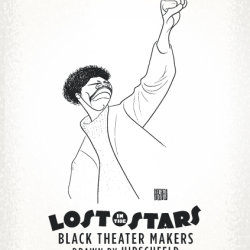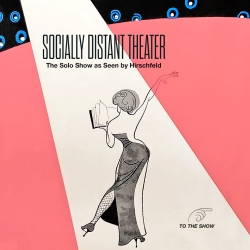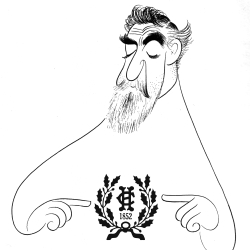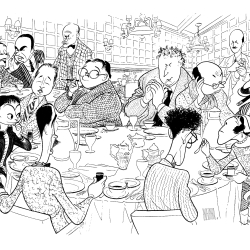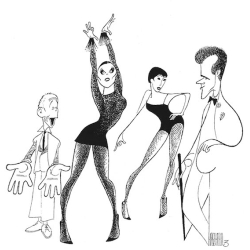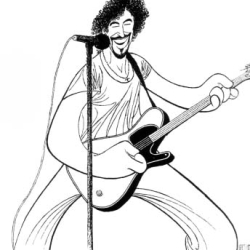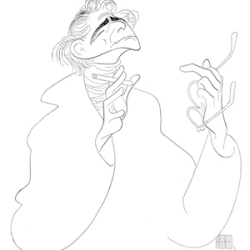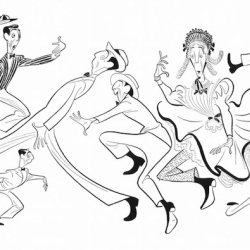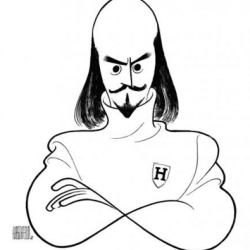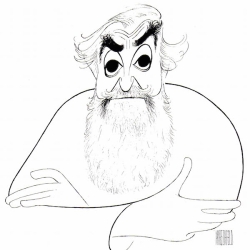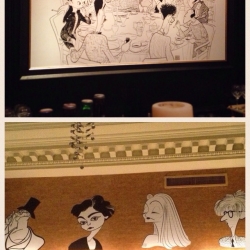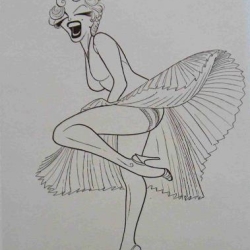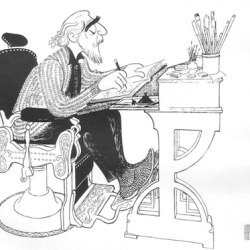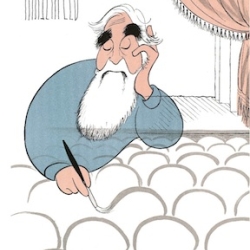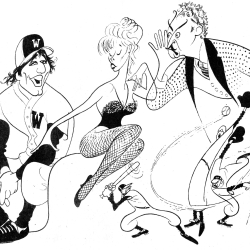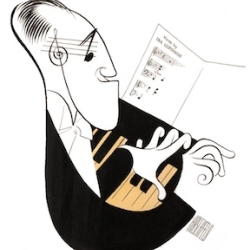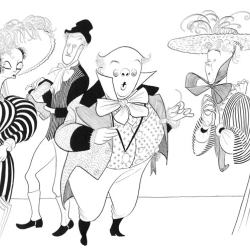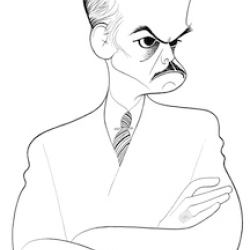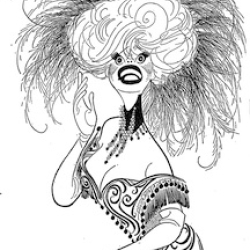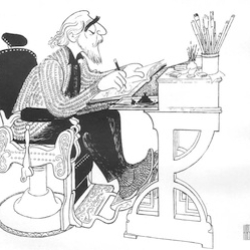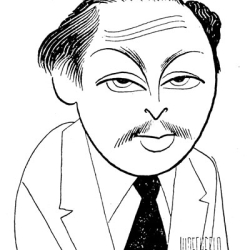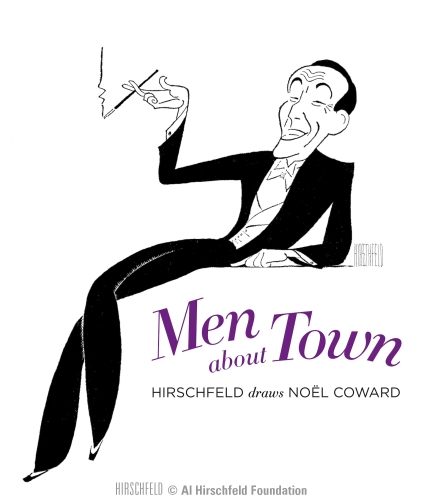
Al Hirschfeld, Characterist, a new show for the Society of Illustrators assembles 25 Hirschfeld drawings—many of which have never been exhibited before—that range from 1937 to 2000. They showcase his remarkable talent for capturing the character of his subjects, while simultaneously providing valuable visual documentation of the world of performance. Noted performers include Groucho Marx, Ed Wynn, the Lunts, Boris Karloff, Vincent Price, Helen Hayes, Jennifer Jones, Burgess Meredith, Nancy Walker, Ruth Gordon, George Segal, Zoe Caldwell, Tim Curry and Fran Leibowitz.
“Hirschfeld was not the best at what he did,” says David Leopold, archivist of the Al Hirschfeld Foundation, “he was the only one who did what he did. Hirschfeld looked with an artist’s eye, but with a journalist’s intent, to capture the magic of performance. He said that his contribution was to take the character, created by the playwright and portrayed by the actor, and reinvent it for the reader.”
Hirschfeld purified the detail of his pictures, and enriched and intensified the viewing experience by communicating volumes in a single stroke. He gleaned the salient characteristics of his subject and transformed the ordinary aspects of an individual into an iconic summary of his or her life or a character’s life. Character is the essence of what Hirschfeld captures in his drawings, providing, in the words of Wendy Wick Reaves, “an epigrammatic portrait.”
“Hirschfeld’s art triumphantly refutes all the misconceptions of caricature,” wrote former Whitney Museum Director Lloyd Goodrich. “There is nothing negative about it; its humor, while sharp edged, is affirmative and gay. It takes all kinds of liberties with literal facts, but it grasps essential truths of character.”
Over nine decades, Hirschfeld saw all the major Eugene O’Neill productions on and off-Broadway. Beginning with Strange Interludein 1928, Hirschfeld captured O’Neill and productions of his work on stage and film 42 times. No other artist so thoroughly documented the work of Eugene O’Neill in the twentieth century.
Hirschfeld looked with an artist’s eye, but with a journalist’s intent, to capture O’Neill’s unique brand of stage magic. Like O’Neill, Hirschfeld was also unconstrained by reality, merging literal details with the playwright’s poetic vision. His contribution, Hirschfeld said, was to take the character, created by the playwright and portrayed by the actor, and reinvent it for the reader. He brought a new set of visual conventions to the task of performance portraiture when he made his debut in 1926. He enriched and intensified the viewing experience, communicating volumes in a single stroke. His signature work, defined by a linear calligraphic style, is serious graphic composition, informed by a distinctly modern aesthetic, and leavened by wit.
Hirschfeld created not only a fascinating archive of O’Neill’s career (both original productions and revivals), but one that gives viewers, then and now, a real sense of the performance and personality of the actors who inhabited these roles. Although opposite in personality, the two men were nevertheless friends who enjoyed haunts in Harlem and 52nd Street together. They spent their lives studying their fellow men and women and interpreting them through their own prisms for their respective (and in many ways shared) audiences.
For almost all of this work, Hirschfeld drew the productions before they received critical acclaim, often in out of town tryouts or rehearsals. Unencumbered by what others thought of the productions, Hirschfeld was free to observe O’Neill’s plays as intended by the writer and his theatrical team.
These drawings give viewers a contemporaneous account, literally drawn from life, of the work of Eugene O’Neill on Broadway and beyond.
First created for New York University's Kimmel Center, this installation was seen by thousands in the summer of 2011, and was very well received.
- ‹ previous
- page 2 of 4
- next ›